I began my series on Mesmerism by analyzing the symbolism of Mesmer’s tombstone. I will begin my series on Sabbatianism the same way. These cemeteries are maintained to this day according to Donme tradition. The Donme sects are the longest lasting Sabbatian sects known to the public, they are the descendants of Sabbatai Sevi’s followers who followed the lead of their apostate messiah by ‘donning the turban’ and converting to Islam, while maintaining their Sabbatian beliefs and practices in secret. Donme cemeteries are rich in symbolism which reflects the secrets of the Sabbatian religion.

One of the greatest mysteries of the Kabbalah is the equation of the Messiah with the Serpent of the tree of knowledge, called ‘Nachash’ in Hebrew. Both of these words share the same numerical value, or Gematria, of 358, (נחש nachash & משיח mashiach = 358). The Messiah and the Nachash are represented as twin serpents, mirror opposites of each other, identical in essence, one ascending, the other descending. The Nachash introduced evil into the world. The Messiah will redeem the world from evil in the final redemption. Sabbatai Sevi, believing himself to be the Messiah, identified with the serpent and signed his name in the shape of a serpent. The motif of the serpent on the tree is a universal symbol recognized throughout the world. For the Sabbatians it depicts their Messiah enshrined on the Tree of Life like Christ on the Cross.
“The gematria of ‘serpent’ is the same as ‘Mashiah,’ and therefore the Zohar likens MALKHUTH and HaMashiah to a serpent. The serpent travels on a crooked path. Likewise HaMashiah must travel on a crooked path in order to rectify the Universe. And this was the path of Shabbathai Sevi. Furthermore, the Zohar states: ‘He bites Her pudendum.’ [2:52B], This is the mystery of the turban.” – Israel Hazzan
The turban crowning Sabbatai’s head resembles a coiled serpent, this is the occult significance of the Messiah ‘donning the turban’ when he converted to Islam.

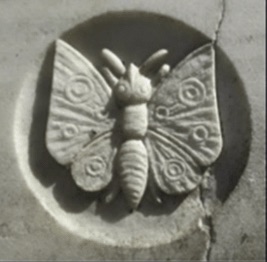
The Moth is another symbol seen over and over again on these Sabbatian tombs. Let us examine the life of the moth in light of what was just discussed about the serpent. The moth begins its life in a serpentine state. It dwells in darkness, concealing itself even further in its cocoon. This cocoon is a shell, a husk. In Kabbalah the realm of evil is called the ‘Kelipah’ meaning a shell or a husk. When the moth emerges from its shell, it is no longer a serpentine worm bound to the ground, it has grown wings to ascend toward the light, as moths are known to gather around light, sometimes extinguishing themselves in the light giving flame. No creature could better symbolize the polarity of Nachash and Messiah, the descending serpent of the shells and the ascending serpent of the light.
Jacob Frank said that initiation took place in the shape of the letter “V” in that one must descend to the lowest point before ascending to the highest point. In other words, one must pass through the world of shells in order to ascend to the higher realms, just as the moth passes through the shell before it ascends toward the light. Descent for the sake if ascent is a concept still central to Chabad Hassidism, although in a much more tame form than that of the radical Sabbatians.
The original Sabbatian prophet, Nathan of Gaza, in his deeply esoteric “Treatise on Dragons,” equates the fin of Leviathan, the great dragon to which the universe is chained, with the “moth that consumes,” noting that the words “fin” (סנפיר) and “moth”(עש) both have a Gematria of 370. This is our earliest and perhaps greatest key to why the Sabbatian Donmeh hold the moth to be such a sacred symbol.

Scholars have discovered other reasons for the moth iconography in Donme cemeteries. The specific kind of moth depicted in these tombs is named Saturnia Pyri after the planet Saturn, called Sabbatai in Hebrew. Saturn plays a significant role in Sabbatianism and Messianic prophecy. (For more on this fascinating aspect of Kabbalah see Moshe Idel’s book on the topic)

While the Moth symbolism subtly alludes to the Messianic role of Saturn, other tombs are more blatant in their Saturnism (a term coined by Moshe Idel, defined as “the belief that the planet Saturn, the seventh known planet in ancient astrology, was appointed upon the Jews, who celebrated the Sabbath, the seventh day of the Jewish week). This tombstone depicts the planet Saturn, clearly emphasized over the other planets, with thirteen stars descending from it. These stars represent the thirteen “chosen” families. They are not necessarily descendants of Sabbatai Sevi, more so the earthly representatives of the Sabbatian Messiah who occupy the elite echelon of the movement. Their relationship to Saturn is clearly depicted here. It’s funny that there are such popular unfounded conspiracy theories about the “thirteen Illuminati bloodlines,” meanwhile there is no discussion of the actual thirteen “chosen” families of Saturn who are “appointed lords of the earth.” (Sisman, page 253) Once again, truth is stranger than fiction.

Notes:

This passage illustrates the paradoxical relationship of the Messiah and the Serpent, the essential unity between the Serpent responsible for the fall, and the Messiah responsible for redeeming the fall. (Scholem, Sabbatai Sevi, page 227)


Leave a Reply